The Sambucus nigra, or elder, has got everything a novice city herbalist might require; delicious, nutritious, healing, and as common as arseholes. Its easy identification was key to drawing me into herbalism and sparking an enduring fascination with this versatile plant. It grows absolutely everywhere on my part of the planet – gardens, parks, motorway roundabouts – and is voracious and fertile. Its ubiquity breeds familiarity, to the point that my children can not only identify it, but can also give identification tips to passers-by. Few things are more gratifying. Handing down the old ways etc.
Both its flowers and berries grow in abundance, although it should be noted that the berries develop from the flowers; so if you want a healthy crop of berries in autumn, don’t pick all the flowers in early summer.
You can, in fact, use the entire plant medicinally – bark and leaves and all – but I am going to focus on just the berries here.
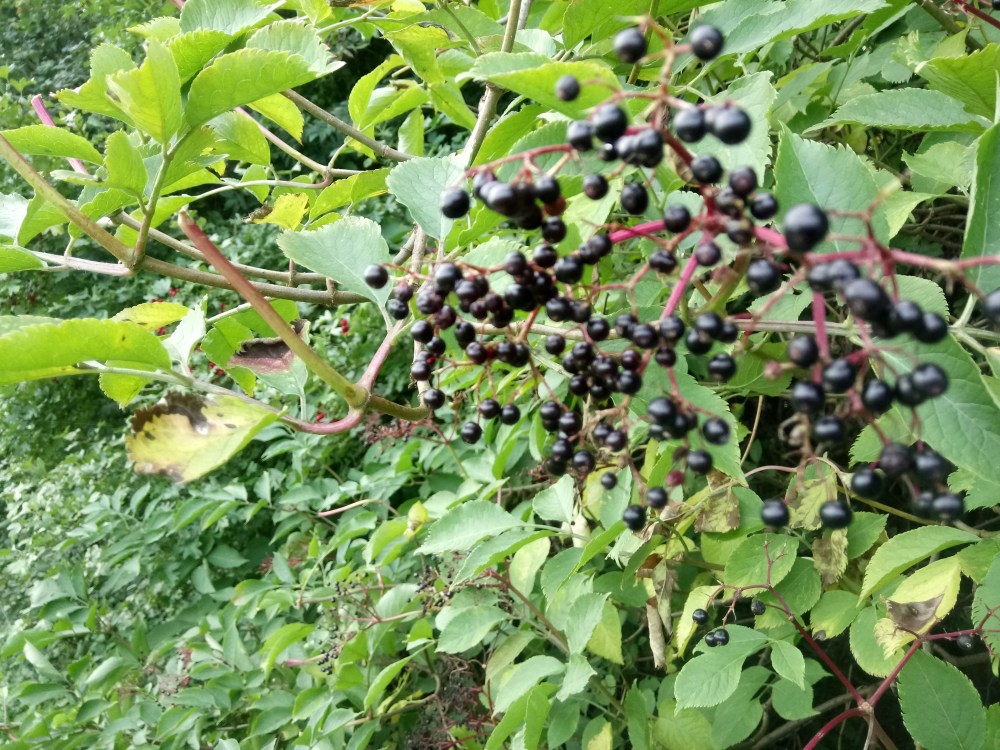
Elder leaf identification
Elder can grow like a shrub, but left untended, can grow to tree-like proportions. Its leaves are compound, i.e., one big leaf made up of several smaller leaves in a feather shape (pinnate). But if this is a bit technical, it can be identified easily by its serrated leaves – which are dark green on one side and almost silvery on the other – and (in autumn) by its red stems. If you’re still not sure, the bunches of small black berries which stain the fingers purple should give the game away.
On this particular September day, we managed to gather 950g of berries, which I thought was a good oul haul for starters. What I didn’t know was that it also represented the last elderberry harvest of the season. Foraging is a precarious game: go out too early and you’ve wasted a day and burst your balloon; too late, and you’ve missed an entire season. And after the initial fragrant, early summer puffs of elderflower have withered, the eager herbalist must wait another two months before the berries have ripened. So as the summer shadows grew longer, I continually checked my patch.
Day after day: “nope not yet”; a week later, “not quite…still a bit green, just a bit longer…”
Then one day you arrive to find the berries are perfectly ripe, but the birds have beaten you to it and eaten half of them. Bastards they are.
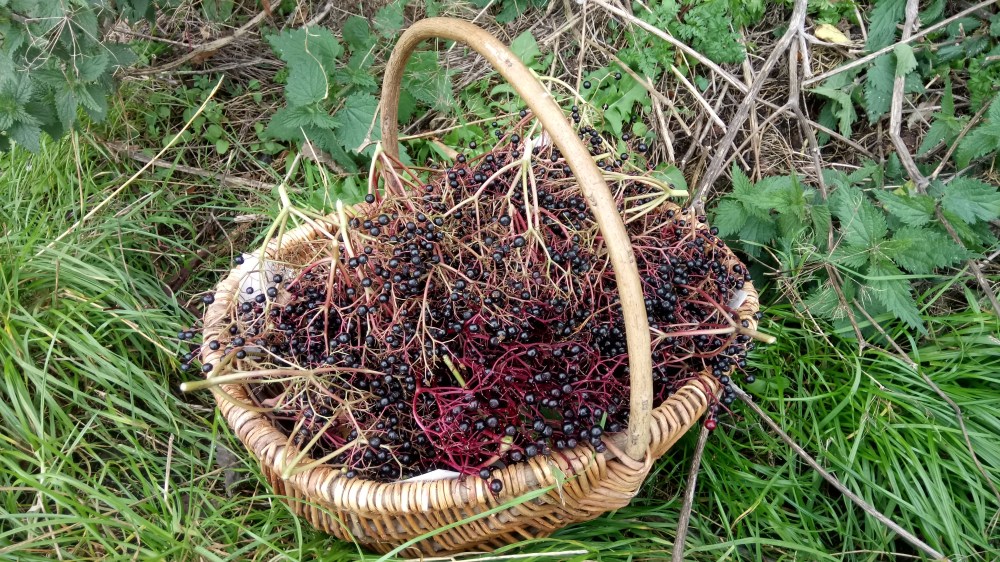
Get a foraging basket
By the way, I sincerely recommend you buy a basket. Nothing else quite does the same job. Certainly not plastic bags, which will make your fruit/herbs/mushrooms sweat and prematurely rot. A wicker basket lets the air in, and is a nice natural material. Oh, and delicious an all as they look, please do not be tempted to eat raw elderberries from the tree – they are mildly posionous! But we’ll come to that…
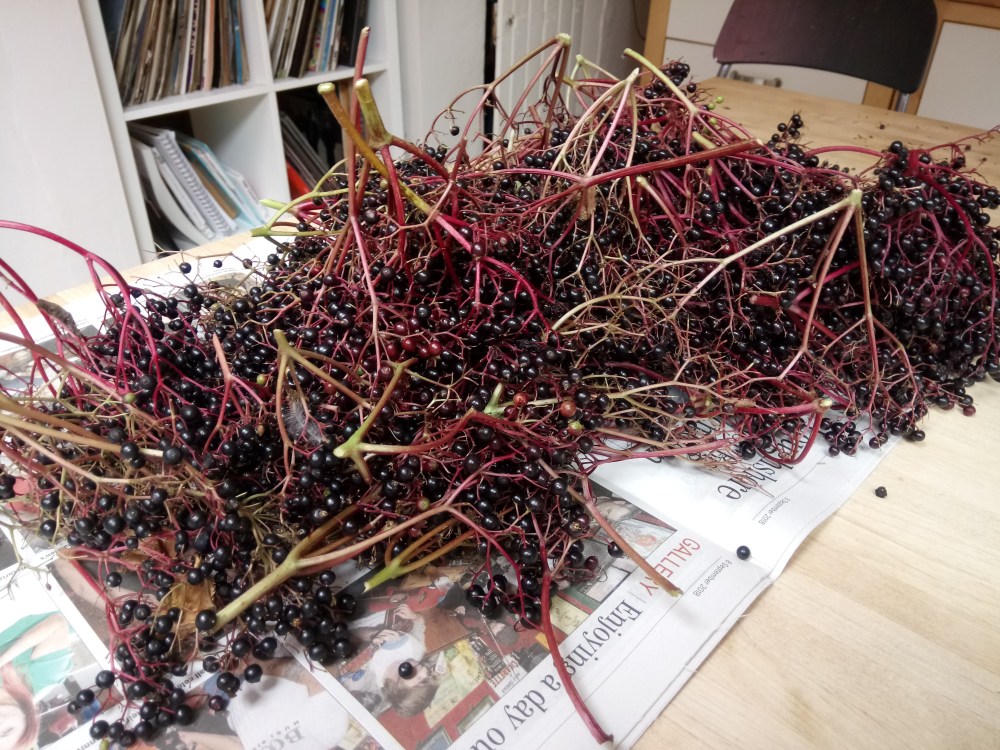
Preparing your elderberries
Once you have your berries, you need to pick them off the stems; and you do need to be conscientious about this, because the stems are bitter and will make you sick. Many folk employ the fork method for this; that is to say, they gently drag the prongs of the fork down the stem, liberating the berries as they go. I’ve developed my own technique of very lightly rubbing the berries off betwixt finger and thumb. Whatever way you do this, be warned that it is pretty time-consuming. Many people consider it to be a frightful pain in the hole, but I recommend that you get zen about it – put on some music, or maybe a podcast, and try not to resist the process. Just let the mind wander…
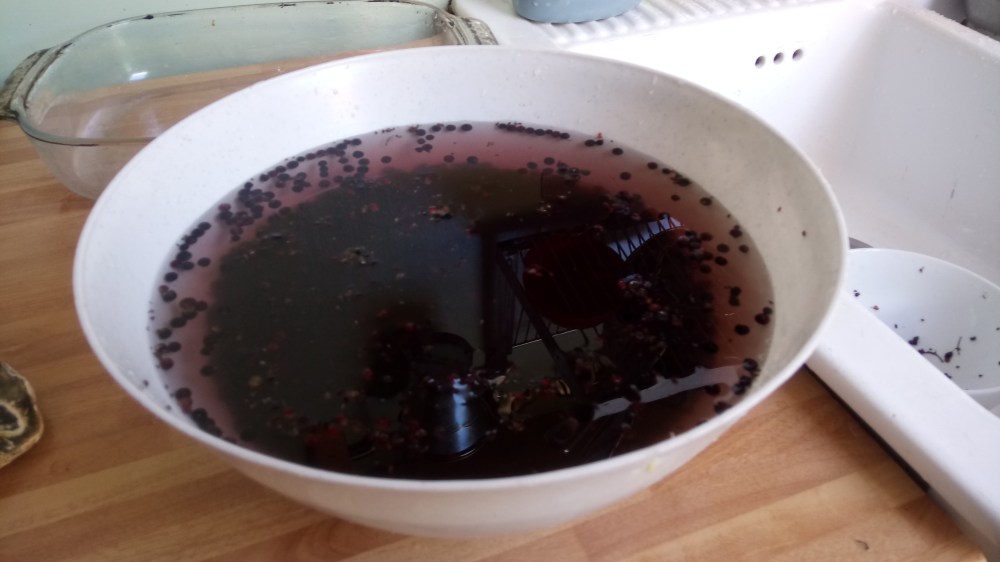
Once you have divorced the berry from the stem, place in a large bowl, and gently rinse to remove any foreign bodies.
Elderberry seeds are poisonous; not lethal, but they will make you pretty ill if you eat them raw, so you’ll need to cook them down. They contain a cyanide-inducing glycoside, and, as the encouragement of cyanide in the body is A Bad Thing, this should be avoided. Luckily, heat treatment will destroy these glycosides without simultaneously destroying all the good stuff. In fact, some research has indicated that heat actually concentrates the inherent polyphenols and anthocyanins.
Simmer the berries for at least forty minutes (I think I had mine on for fifty) in a deep stainless steel pan, stirring occasionally and crushing with the spoon as you go. Your berries should eventually change from this…
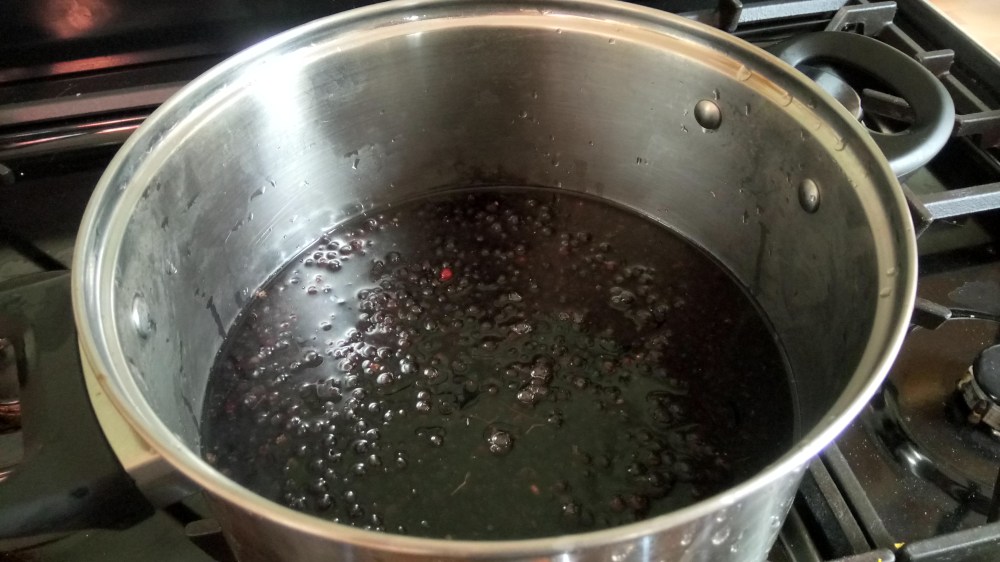
…to this:
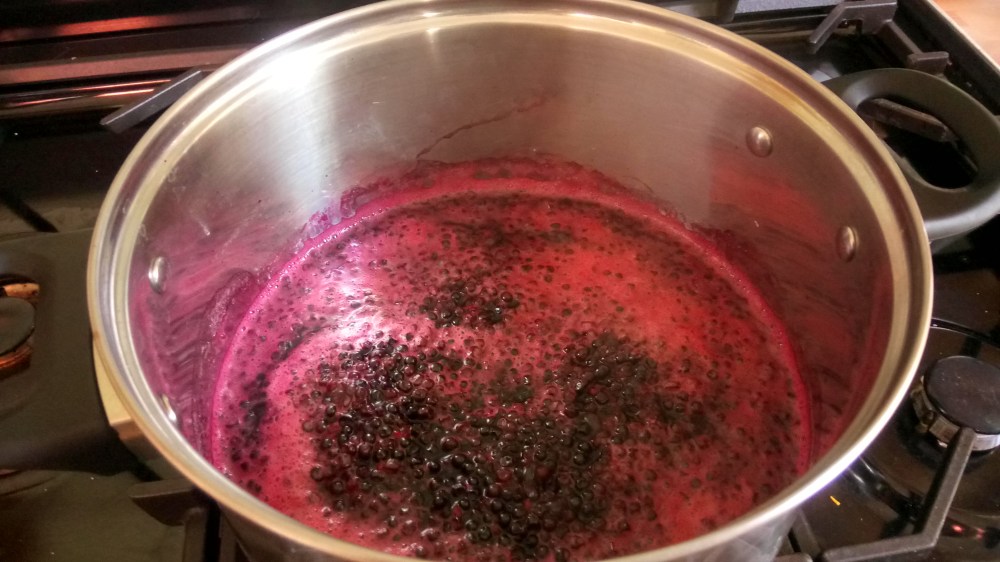
Strain through a sieve, pressing down and crushing with a spoon as you go – you want to extract all the goodness you can at this stage.
The smell of the elderberry
There’s something else that’s worthy of a mention though: the smell of simmering elderberries is a decidedly odd thing. Kind of, well, meaty. Honestly!
Try not to be put off by the gamey whiff, because having done all this and tasted the results, I was absolutely blown away by the flavour. Strange to say that never, in all my 45 years, have I tasted the datey-blackcurranty elderberry before in any of its forms, but I’m already looking forward to gathering as many as I can next year for pies, crumbles, wine, and chutneys.
Sugar and medicine
What you do with your extracted elderberry juice is all important. I have read many a recipe for syrup, and for lozenges which utilise the antibacterial properties of the elderberry to act upon the respiratory system when coughs and colds appear. What many of these recipes recommend is to use sugar to sweeten the juice. This is madness. If you are making elderberry sweets or desserts, it won’t matter; but if you are making medicine, it most certainly will.
Sugar is inflammatory in the extreme. Chronic disease is often caused by inflammation. If you have succumbed to an infection, you will be relying on your immune system to fight it. Sugar suppresses the immune system. Sugar also fucks with your gastro-intestinal microbiome, which is the root of good health. QED: do not put sugar in your medicine.
Instead, why not use the best honey you can afford; preferably raw, perhaps Manuka – you get the idea. By the way, the sugars found in honey are complex ones which have already been pre-digested in the bee’s gut, and are not isolated from the other complementary compounds, making them easily digested by humans.
Preparing medicinal elderberry syrup
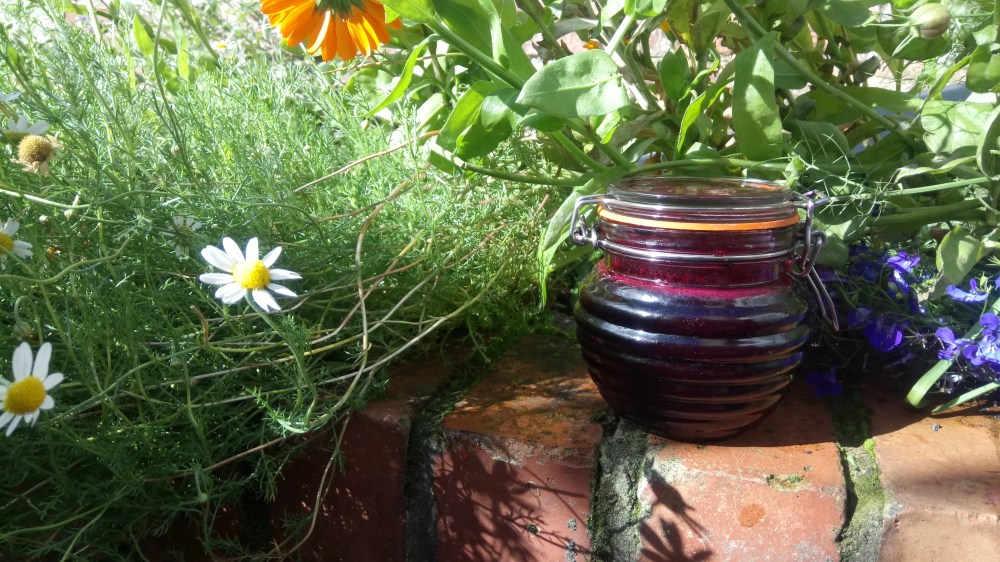
Now I’ll be honest with you, I went about this next stage a little bit gung-ho. Firstly, I decanted the juice into a small Kilner jar, but then left it for a few days. I used a good, raw, organic honey; however, rather than research and precisely measure how much honey to add, I guessed.
The result? The syrup tasted amazing, but it wasn’t sufficiently preserved. In fact, it fermented. So now, I have a slightly fizzy, ever-so-slightly boozy elderberry tonic.
Medicinal properties of elderberries
I was keen to find out if elderberries are as potent as both tradition and research would suggest, but I didn’t have long to wait. Schools are like Petri dishes, and when my young lads went back there after the summer holidays, right on schedule, the tickly coughs and sniffles appeared. I can say, honestly, that a nasty enough cough developed in child A; but then again, he did not take the syrup as regularly as he should have. When I reminded him to take his medicine, there was a noticeable suppression of respiratory irritation, and a reduction in symptoms.
I can personally testify that I developed a tickly throat with some slight swelling, a week or so later. I got right on it with 2-3 tablespoons of syrup first thing in the morning and last thing at night. This time, there was a total suppression of symptoms.
Fast forward a month: my wife felt the beginnings of a bladder/urinary tract infection, and went to get the SP from the GP. She was informed that there was indeed an infection, that her blood reading was pretty high, and that to prevent the infection spreading to the kidney she should take a course of antibiotics. To complicate matters, she also began to develop a nasty-looking throat infection.
When asked my opinion, I told her that I would always try and fight an infection naturally, but ultimately, it was her decision. She decided to give it a go, and devised a daily protocol of three tablespoons of elderberry, day and night; two tablespoons of apple cider vinegar, twice a day; and 5600mg (four capsules) of garlic every day. This treatment was designed to provide the maximum antimicrobial and immunity-boosting benefits. As I write, this treatment is ongoing; however, after one week, my wife reported a marked decrease in pain and discomfort, and now feels like she’s on the road to recovery. The throat infection completely disappeared after two days.
Medical research on elderberry
This is, of course, anecdotal evidence, but there’s nothing wrong with that, as such. The wisdom of traditional medicines is anecdotal by definition. However, there is loads of research out there (despite what Big Pharma might lead you to believe) for the scienceheads. Start with some research on elderberry here and here; a study from January 2018 confirming the antimicrobial activity of apple cider vinegar; and evidence of the antibacterial activity of garlic here. For tonnes of evidence-based research on natural healing, I find greenmedinfo.com a fantastic resource. Here’s what they have on elderberry.
Herbal energetics
I want to say something briefly about herbal energetics. One of the misunderstandings of plant-based remedies is that they will work in the same way as pharmaceuticals; i.e., feel the dis-ease, take the cure, feel better. Different herbs will have different energetic properties, such as relaxing, stimulating, astringent, and so forth. But some herbs contain several different energetic properties, and, furthermore, every human being has been constructed in a slightly different way and so will react to the ingestion of various chemicals in slightly different ways. To heal effectively, the energetics of the herb must be in harmony with those of the user. This topic will be explored more thoroughly in future posts.
What I’m getting at is that natural remedies can be easily dismissed as ineffective, on the basis that they do not work as quickly or as dramatically as the user might expect. But, I am prepared to have patience with plants, and to have faith in the power of my human body to heal itself, given the right fuel.
Elderberry contains flavonoids, anthocyanins, vitamins A and C, sambunigrin (cyanogenic glycoside), sambucine (alkaloid), organic acids and vitamins. I could go on and on about the symbolism and spiritual resonance of elder too, but I just ain’t gots the time! But if you’re interested in all things pagan/folklorey I found the following links to be interesting.
https://normsfarms.com/blogs/growing-and-harvesting-elderberry/elder-tree-folklore-part-1
https://treesforlife.org.uk/forest/mythology-folklore/elder/
https://www.druidry.org/library/trees/tree-lore-elder
https://www.selfsufficientish.com/main/2013/06/elder-folklore-and-growing/ (growing Elder)
http://www.thegoddesstree.com/trees/Elder.htm
http://irishhedgerows.weebly.com/flora.html
 Herbal Urban